






Work Smarter, Not Harder: The New Rules of Cardio

If you have scrolled through fitness or longevity social media lately, you have may heard a lot of buzzwords thrown around: Zone 2, SIT, VO2 Max, and the Norwegian 4x4. It can feel overwhelming to stay up to speed and piece them all together into an actual routine. My goal is always to alchemize this information into understandable, actionable steps so we can work more efficiently to achieve optimal results.
In this post, we are combining baseline medical frameworks with the cutting-edge insights of two top experts in the human optimization: Dr. Rhonda Patrick (biomedical scientist) and Dr. Stacy Sims (leading exercise physiologist and nutrition scientist specializing in female biology) to give you a definitive guide to building a strong, resilient, and younger heart.
The Standard Baseline (AHA Guidelines)
Before diving into high-performance protocols, the American Heart Association establishes the absolute baseline for preventing cardiovascular disease (Polyak, 2026):
- 150 minutes of moderate-intensity aerobic exercise per week, or
- 75 minutes of vigorous-intensity aerobic exercise per week
Think of this as your biological insurance policy. If you hit these weekly goals consistently, you lower your risk of cardiovascular events drastically. But if you want to optimize your lifespan and brain health, we need to talk about how you structure those minutes.
- The Aerobic Foundation: Zone 2 Training
Zone 2 training is a low-intensity, steady-state (LISS) cardio approach.
- What it is: An intensity where your body relies almost entirely on oxygen and fat to create energy (aerobic respiration), sparing glucose.
- The intensity test: You can maintain a full conversation, but the person on the other end of the phone definitely knows you are exercising.
- Why it matters: It forces your muscle cells to build more mitochondria (the powerhouses of your cells). More mitochondria means better metabolic health, more energy, and a lower resting heart rate.
The Rhonda Patrick View: Half Your Time
Dr. Rhonda Patrick emphasizes that for optimal health span, casual and committed exercisers alike should ensure they are pairing their high-intensity days with plenty of aerobic volume. She notes that Zone 2 acts as the aerobic foundation, allowing your cardiovascular system to safely handle the stress of maximal output days.
The Stacy Sims Nuance: Women Are Not Small Men
This is where Dr. Stacy Sims’ iconic mantra comes into play: “Women are not small men”. Dr. Sims points out that women naturally have an incredibly efficient baseline fat-burning metabolism due to their hormonal makeup.
Because of this, women don't always need to grind out hours and hours of slow, steady Zone 2 in the same way men do to get metabolic benefits. Dr. Sims advises women—especially pre- and postmenopausal women—to focus heavily on high-quality, high-intensity stimulus, using Zone 2 as active recovery rather than the sole focus of their programming.
- The Longevity Standard: High Intensity & SIT
If Zone 2 builds the size of your engine, high-intensity training increases its top speed. Top speed is measured by your VO2 Max—the maximum amount of oxygen your body can utilize during hard exercise. Your VO2 Max is one of the strongest statistical predictors of how long you will live.
Dr. Rhonda Patrick points out that vigorous exercise stimulates radical structural changes in the heart, making it more plastic, thicker, and better at pumping blood to the brain and organs.
Two main protocols dominate the high-intensity conversation:
Protocol A: Sprint Intensity Training (SIT)
- The Format: Short, maximal-effort bursts followed by complete rest. Think an all-out 30-second sprint on a stationary bike, followed by 2 to 3 minutes of easy spinning. Repeat 4 to 6 times. Start with a few rounds and increase rounds and intensity over time.
- Dr. Stacy Sims' Take: This is Dr. Sims’ preferred option for women. All-out sprints create a unique neuroendocrine response that triggers muscle growth, burns visceral fat(unhealthy fat around the middle), and improves insulin sensitivity without spiking the stress hormone cortisol the way long, exhaustive cardio sessions can.
Protocol B: The Norwegian 4x4
- The Format: 4 minutes of hard exertion (aiming for roughly 85–95% of your maximum heart rate), followed by 3 minutes of active recovery (easy jogging/walking/cycling). Repeat this loop 4 times total. Start gently and work to greater intensity over time.
- The Science: This protocol is widely considered the gold-standard for rapidly increasing VO2 max because it forces the stroke volume of your heart to stay at its absolute peak for an extended period. Research studies have shown when subjects exercise using the Norwegian 4x4 protocol, they decrease the aging of their heart by up to 20 years!
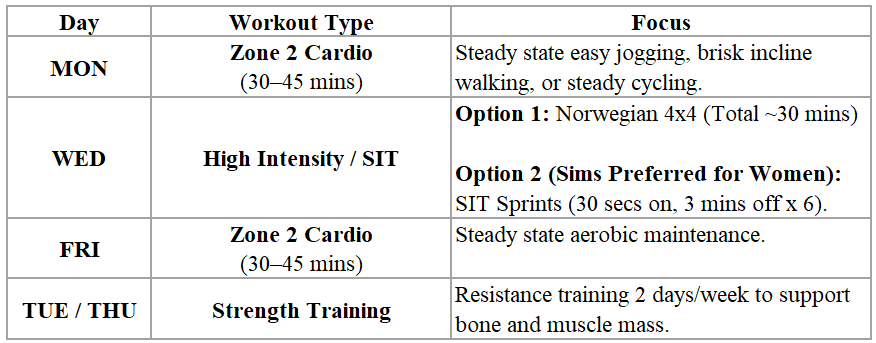
How to Package This Into Your Week
How do you combine these rules into a realistic schedule? A balanced, optimized weekly layout looks like this:
⚠️ DISCLAIMER: Please consult your physician or other health professional before starting any rigorous exercise program. Take your time and work slowly to gradually increase your intensity levels. Progressing too quickly can lead to injuries like tendonitis, muscle strains, or stress fractures. If you currently are not exercising at this intensity, healing from an injury, or would just like guidance as to how to progress your exercise, please reach out for a free Discovery Call and we will take this on together.
Our goal in this community is to build steady, sustainable, and healthy lifestyle practices into our daily routines. There is no race when it comes to health — it is a lifelong marathon. The key is to just get going and then safely progress over time to prevent set backs and injuries.
Summary Checklist for Success
- Find your baseline: Make sure you are hitting a minimum of 150 minutes of weekly moderate intensity aerobic movement.
- Check your intensity: Use the "talk test" to keep your Zone 2 truly easy, and your high-intensity days truly hard.
- Tailor to your biology: If you are a woman, lean heavily into short, sharp power outputs (SIT) rather than draining yourself with endless long-distance cardio.
References:
Dr. Rhonda Patrick: www.foundmyfitness.com
Dr. Stacy Sims: www.drstacysims.com
Research study referenced for the latest cardiovascular guidelines: Polyak, A. (2026). Physical activity and cardiovascular health. https://onlinelibrary.wiley.com/doi/10.1155/jdr/3341765
Curious to stay informed about the latest in health and longevity? Join us in our Vitality Community.